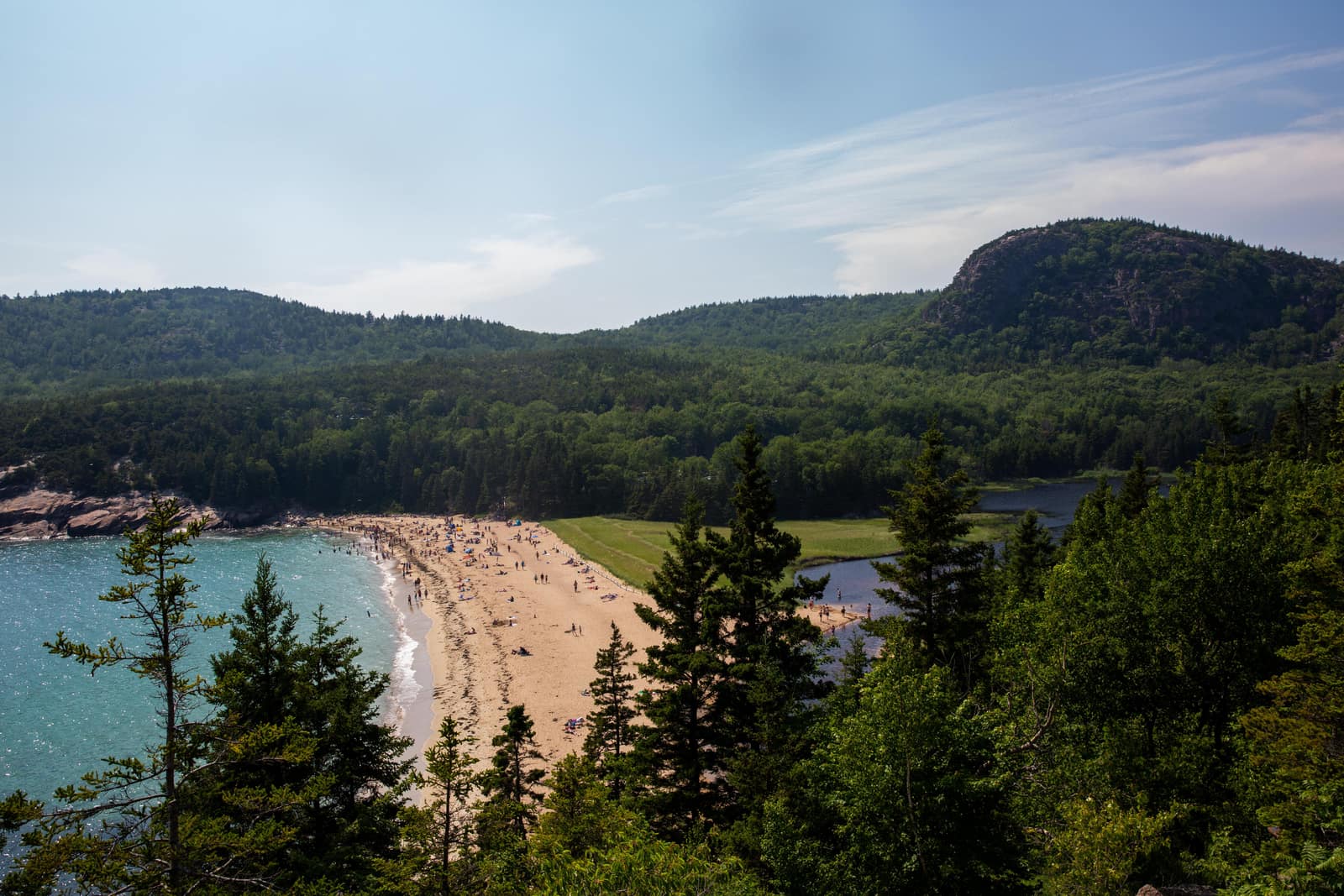
The Beehive Trail in Acadia National Park is one of those hikes that looks manageable on paper and stops people cold once they’re on the rock. It’s short, about 1.4 miles round-trip, and gains only 450 feet. What the numbers don’t convey is that a good portion of that climb involves pulling yourself up iron rungs and wooden bridges bolted directly into a near-vertical granite cliff face. If you’re fine with exposure and don’t mind using your hands, the views of Sand Beach curving below you and the open Atlantic beyond make it one of the more memorable short hikes on the East Coast. If heights give you trouble, the Ocean Path at the base covers much of the same scenery on flat ground.
What the Beehive Trail Is
The Beehive is a rounded granite peak above Sand Beach, not the tallest summit in the park but one of the most abrupt. The trail up its east face is classified by Acadia as “strenuous” because the route traverses the sheer cliff rather than climbing a ridge or a forested slope. The iron rungs, handholds, and short wooden bridges are the trail. Without them, the face would require technical climbing gear. With them, most reasonably fit adults in good footwear can manage the ascent, but it requires continuous attention to hand and foot placement.
The trail is a one-way ascent. You climb the Beehive face and return via the Bowl Trail, which drops through the woods to the pond above the cliff (called The Bowl) and back to the Sand Beach parking area. The full loop runs about 1.8 miles. Don’t attempt to descend the face the way you came; backing down iron rungs on a steep cliff is how people get hurt. Go up the Beehive, come down via the Bowl Trail.
Acadia does not allow dogs on the Beehive Trail or any of the park’s iron rung trails. This is a firm park rule, not a suggestion. If you’re traveling with a dog, the Ocean Path below or the carriage road network are better options.
The Route, Section by Section
The trailhead sits at the Sand Beach parking area on Park Loop Road, about 5 miles from the center of Bar Harbor via the Park Loop. There’s a small bulletin board near the beach access path where the Beehive Trail splits off to the left toward the base of the cliff. The first few hundred yards are a standard rocky trail through spruce forest, rising gradually before the route tilts steeply upward onto open granite.
Once you hit the cliff, the rung sections begin. The climb comes in stages: a stretch of iron rungs anchored to vertical granite, then a narrow ledge traverse, then another set of rungs or handholds, then a short wooden bridge across a gap. The spacing is manageable for adults but awkward for small children, which is why the trail carries a de facto height recommendation. You want to be comfortable putting your full weight on the rungs while reaching for the next one above, and you want to be steady enough that a moment’s wobble doesn’t pull you off balance.
The views open up quickly. By the first major ledge, you’re high enough to see Sand Beach laid out directly below, the pink granite headland of Great Head across the cove, and the Atlantic stretching to the horizon. Higher up, the perspective shifts: the beach shrinks, the ocean widens, and you can pick out the Otter Cliffs headland to the south and Bar Island in Frenchman Bay to the north.
The summit itself is a broad, open granite dome. There’s a cairn and a wooden sign. On clear days you can see Champlain Mountain to the northeast, the hills on the Schoodic Peninsula across the water, and the islands clustered in the bay. The wind picks up considerably at the top. Bring a layer regardless of the temperature at the Sand Beach parking area.
Iron Rungs: What to Know Before You Start
The rungs are solid and well-maintained, but they are metal on exposed rock, and they get slick when wet. That’s the main reason to check the weather before you go, not just for the summit but for conditions that morning. A light drizzle from the night before can leave the rock damp well into mid-morning, and wet granite is considerably harder to trust on a steep face than dry granite. If there’s been significant rain in the 24 hours before your planned hike, plan to do something else that morning or wait until afternoon if the forecast clears.
Footwear matters more on this trail than on most of Acadia’s hikes. Approach shoes or trail runners with sticky rubber soles make the difference between feeling confident on the rock and spending the whole climb focused on not slipping. Casual sneakers with worn-out soles are a bad idea here. Sandals are worse.
Gloves aren’t standard kit for summer hikers in Maine, but they make a difference on the upper rung sections where the granite edges are sharp and the hand positions aren’t always comfortable. A light pair of work gloves or thin trail gloves can take the edge off a two-hour grip on rough rock.
One practical note: the Sand Beach parking area has restrooms. There are none at the summit or at The Bowl. Use them before you start.
The View From the Top, and Down Into the Bowl
From the summit, the descent route drops away from the cliff edge and into the woods toward The Bowl, the small glacial pond that sits in the cirque above the Beehive’s east face. The Bowl Trail is a marked path, not technical, and it brings you down through mixed spruce and birch forest to the pond. The Bowl itself is worth a few minutes: the water is clear, the Beehive cliff rises sharply behind it, and it’s quiet in a way that the beach and parking area below never are.
From The Bowl, the trail continues south and drops back to the Sand Beach parking area, completing the loop. The descent is standard rocky trail, steep in spots, but nothing like the face you just came up.
If you have time after the loop, the Ocean Path runs north from the parking area to Thunder Hole and Otter Cliffs, two of the most visited spots on the Park Loop Road. Thunder Hole is about 0.5 miles from Sand Beach, a narrow inlet where the incoming surf compresses into a rock chamber and, when the swell and tide align, lets out a loud crack and throws spray 20 to 40 feet into the air. It’s unpredictable, but the walk along the pink granite shoreline to get there is worth doing regardless.
When to Hike the Beehive, and When to Skip It
The Beehive Trail is open from spring through late fall, though conditions vary significantly by season. Summer (late June through August) is the most crowded window. The Sand Beach parking area fills by 8 or 9 AM on clear summer days, and the Beehive face can have enough people on it that you’re occasionally waiting on ledges for the group above to clear. Early morning, before 8 AM, is consistently the best time in summer.
September and early October are the best months to hike the Beehive. The crowds thin substantially after Labor Day, leaf color starts to turn in the woods above The Bowl, and the air is cool enough to make the climb comfortable. The Island Explorer shuttle still runs through Columbus Day, so getting to Sand Beach from Bar Harbor without a car is possible well into fall. Our post on visiting Acadia without a car covers how the shuttle system works.
Spring (April and May) is hit or miss. The trail can be muddy and the rungs may have ice in early spring. The park sometimes closes the iron rung trails during mud season to protect the trail surface. Check current conditions at nps.gov/acad or call the park information line before heading out.
Do not attempt the Beehive face in wet conditions, in fog with reduced visibility, or if there is any ice on the rock. Those are the conditions where the trail earns its reputation for rescues.
Getting to the Sand Beach Trailhead
The Sand Beach parking area is on Park Loop Road, the one-way scenic drive on the eastern side of Mount Desert Island. From Bar Harbor, take ME-3 south to the park entrance station, then follow Park Loop Road; Sand Beach is about 5 miles from Bar Harbor. Allow 20 to 25 minutes.
You need the standard Acadia entrance pass to enter the park (around $35 per vehicle for a 7-day pass; verify current pricing at nps.gov/acad). Sand Beach does not require a separate timed entry reservation the way Cadillac Summit Road does.
The lot fills fast on clear summer days. Arriving by 7:30 AM gives you a solid chance of getting a spot. The Island Explorer Route 3 shuttle from Bar Harbor stops at Sand Beach in season and removes the parking problem entirely.
Practical Tips
- Wear closed-toe shoes with rubber soles. The trail is not sandal-appropriate.
- Check nps.gov/acad for current trail status before you go, especially after rain.
- Dogs are not permitted on the Beehive Trail. Leave them at the trailhead or hike a different route.
- Bring water. There’s no water on the trail.
- The loop takes most hikers 1.5 to 2.5 hours.
- If heights make you hesitant, the Bowl Trail visits The Bowl without any rung climbing.
For a broader look at the trails inside the park, from easy carriage road walks to longer ridge routes, the Maine hiking guide and the best Acadia hikes page have the full rundown. If you’re pairing the Beehive with a sunrise, Cadillac Mountain is about 4 miles away by car, and doing the sunrise first and the Beehive after puts you back at Sand Beach well before the midday crowds arrive.
Frequently Asked Questions
How hard is the Beehive Trail in Acadia?
Short (about 1.4 miles round-trip) but strenuous. The challenge is not distance or total elevation gain (about 450 feet) but the technical nature of the climb: iron rungs and handholds bolted into a steep granite face. Anyone comfortable with exposure and reasonably fit can complete it, but it is not a beginner trail.
Are dogs allowed on the Beehive Trail?
No. Acadia does not permit dogs on the Beehive Trail or any of its iron rung trails. Dogs are welcome on most other park trails and on the carriage roads.
Can you descend the Beehive the way you came up?
The park advises against it. Back off the top via the Bowl Trail, which is the standard loop finish. The posted signs at the summit point you the right way.
When is the Sand Beach parking lot full?
In July and August, frequently by 8 to 9 AM on clear days. Arrive before 7:30 AM or take the free Island Explorer shuttle from Bar Harbor (Route 3, stops at Sand Beach, runs late June through Columbus Day).
How long does the Beehive Trail take?
Most hikers finish the loop in 1.5 to 2.5 hours, including time at the summit and The Bowl. The cliff ascent is slow by nature; you’re moving deliberately from rung to rung.